Semrush review: we audited our own site on the free plan
We ran a Semrush site audit on tooldebrief.com and researched our next article on the free plan. The audit found a real fix; the keyword data stops at 10 rows.
ToolDebrief earns a commission if you buy through some links on this page. It costs you nothing extra and never changes the verdict. How this works.
The free Site Audit crawled our site in under a minute and found a real problem we had missed in our review markup. The keyword research shows real numbers but only the first 10 of 357 ideas. Free is worth having for a small site; paid plans start at $139 a month, which only makes sense once SEO is a real part of your income.
- Site Audit crawled our 23 pages in under a minute and found a real fix we had missed
- Each issue lists the affected pages and the exact missing fields
- It correctly spotted the one page we block from search on purpose
- Keyword results show volume, difficulty, intent and cost per click side by side
- No card and no Google account needed to start
- Keyword Magic Tool showed only 10 of the 357 keywords it found
- Core Web Vitals and other reports are paid only
- After one audit of 23 pages, it would not let us re-run it until next month
- Paid plans start at $139 a month, or $117 a month billed yearly
- Upgrade prompts and "Start free trial" buttons appear on nearly every screen
Price · Free with limits; SEO Pro $139 a month ($117.33 billed yearly); Semrush One Starter with AI visibility $199 a month ($165.17 billed yearly) (checked 14 November 2026)
Semrush is one of the best-known SEO tools, and one of the most expensive. Most people only need it for two jobs: checking their own site for problems and finding out what people search for. We tested whether the free plan can do both for a small site: this one.
What we tested
On 14 November 2026 we opened a new Semrush account on the free plan, with no trial and no payment card. We did not connect Google Search Console or Google Analytics.
We gave it two real jobs:
- Audit tooldebrief.com, a new site with 23 pages, and see whether it finds anything we did not already know.
- Research our next article. We have just published a Grammarly review, so we looked up what people search for when they want an alternative to Grammarly.
What happened
Setting up the project
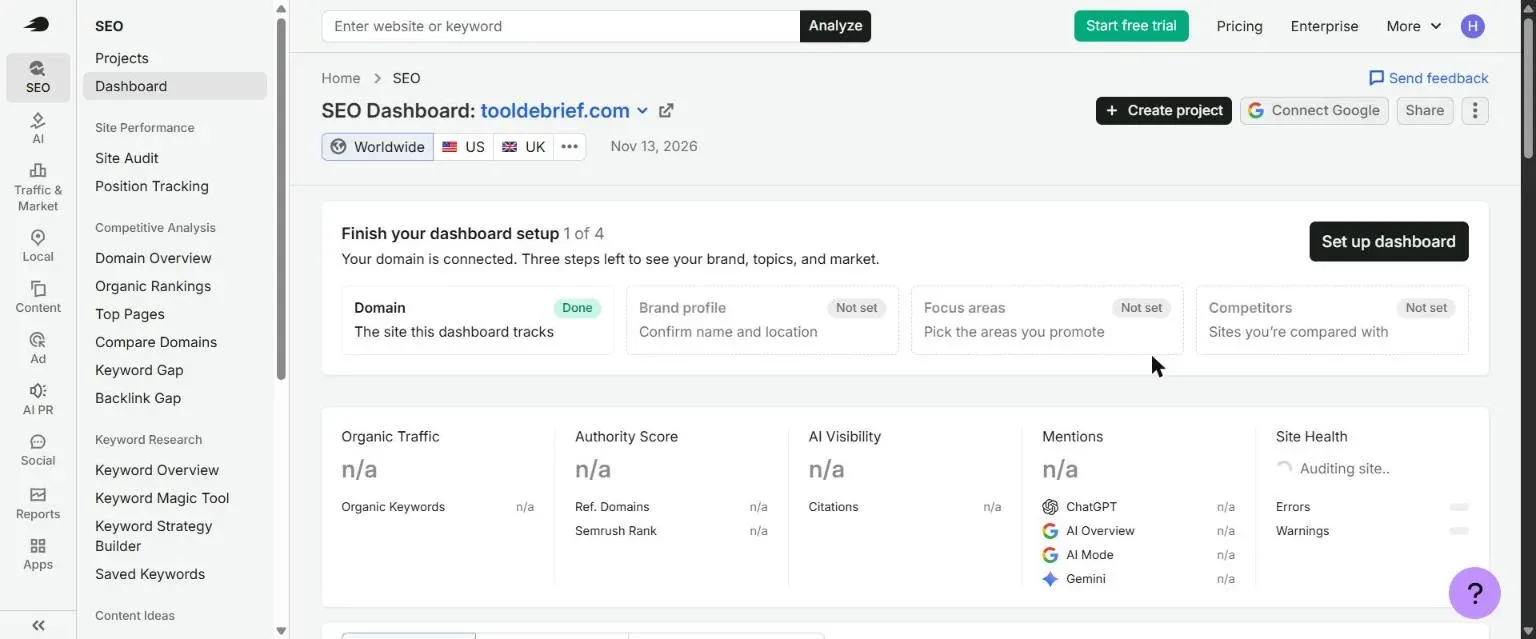
Semrush opens on a single box: enter a website. We typed tooldebrief.com and it created a
project and an SEO dashboard straight away, and started a site audit in the background.
Every number on the dashboard said n/a: organic traffic, Authority Score, AI visibility and mentions in ChatGPT and Google’s AI answers. That is fair for a site this new, but it means the dashboard has nothing to show a small site yet. The audit is where the free plan earns its keep.
The site audit: 97% and one real problem
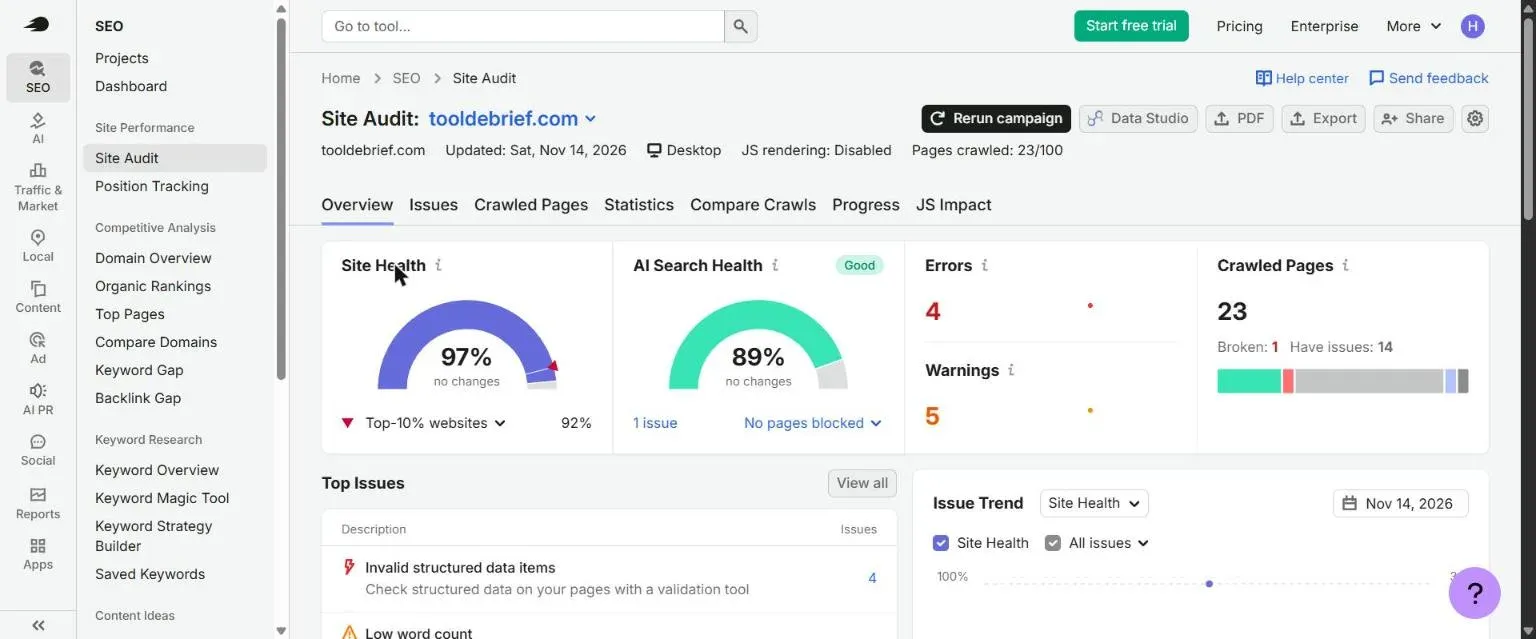
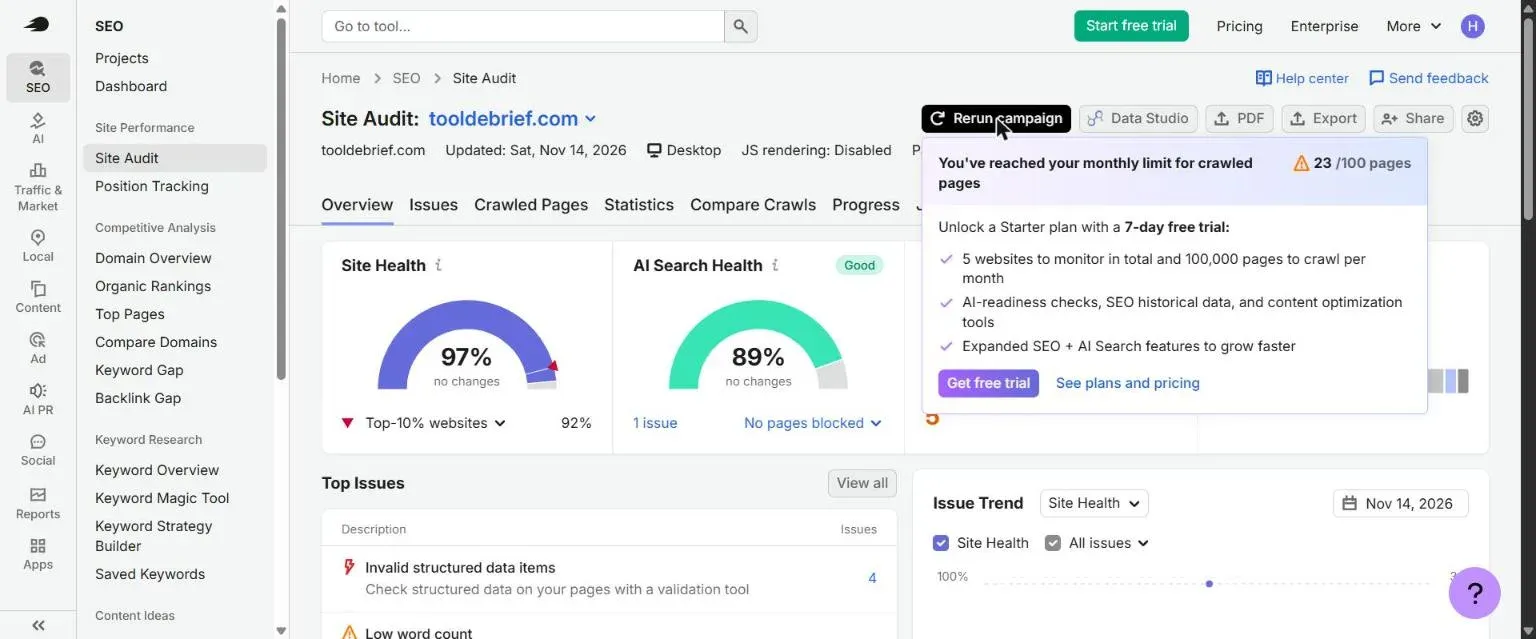
The audit finished in under a minute. It crawled 23 of a possible 100 pages and gave the site a Site Health score of 97% and an AI Search Health score of 89%.
It listed seven types of issue. We checked each one against the site:
| What Semrush flagged | Was it right? |
|---|---|
| 4 structured data items are invalid | Yes. A real problem we had missed (see below). |
| 5 pages have a low word count | Yes. They are our section pages, which are short lists of articles. |
| 4 outgoing links are nofollow | Yes, on purpose: affiliate links should be marked this way. |
| 1 page is blocked from crawling | Yes, on purpose: our Alternatives section is empty, so we keep it out of search. |
| 2 subdomains don’t support HSTS | A minor security setting, worth a look. |
| llms.txt not found | An optional file for AI tools; Google ignores it. |
| 1 page has only one internal link | Yes, an easy fix with a few more links. |
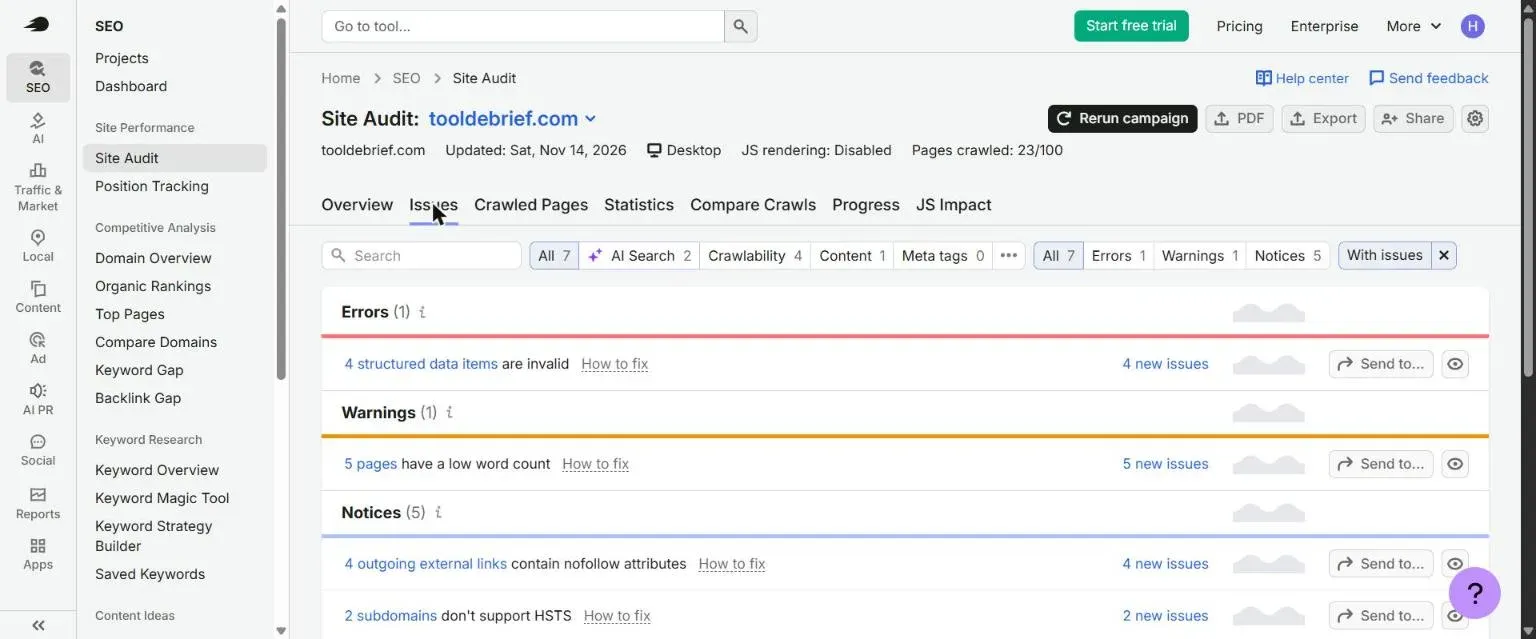
Nothing here was invented. Two of the seven are things we did deliberately, and Semrush has no way to know that, so it is worth reading each one before you fix it.
The finding we had missed
The one error was on all four of our reviews. Each review page tells search engines, in hidden
code, that it reviews a piece of software and gives it a score out of 10. Semrush clicked through to
the exact problem: the software entry was missing two fields, a price (offers) and a
rating (aggregateRating or review).
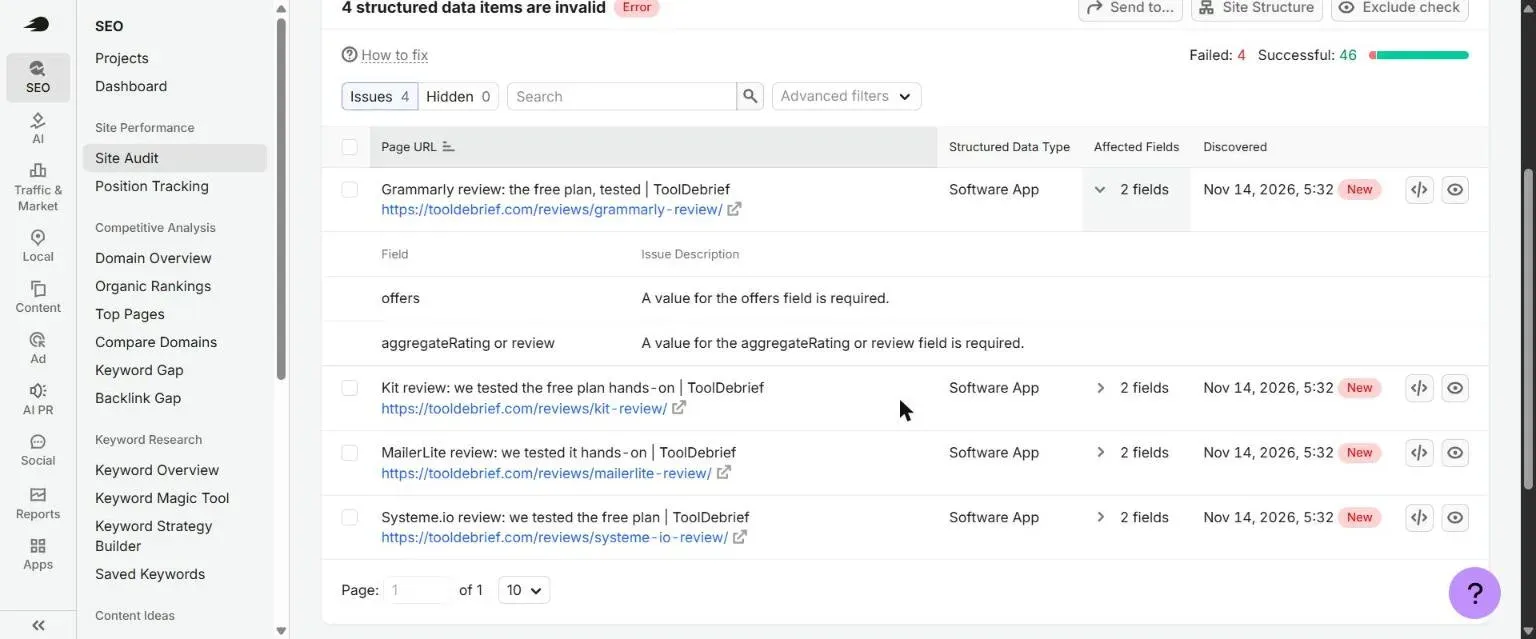
Our rating is already there, but the software entry sits inside the review rather than the other way round, which is why a checker can miss it. The missing price was a real gap, and we would not have found it without the audit.
We fixed it the same day: the software is now the main item, with a price and our review inside it. Google’s Rich Results Test now shows the markup as valid on our reviews.
We could not re-run the audit
After the fix, we clicked Rerun campaign to confirm it in Semrush. The free plan refused: “You’ve reached your monthly limit for crawled pages”, next to a counter that read 23 / 100 pages. We had used fewer than a quarter of the pages, but one audit used up the month. To check a fix in Semrush on the free plan, you wait for next month or start the trial.
Keyword research: real numbers, 10 rows
Next we searched for “grammarly alternative” in the Keyword Magic Tool, set to the United States. Semrush found 357 related keywords with a combined 10,890 searches a month, and an average difficulty of 19%, which is low.
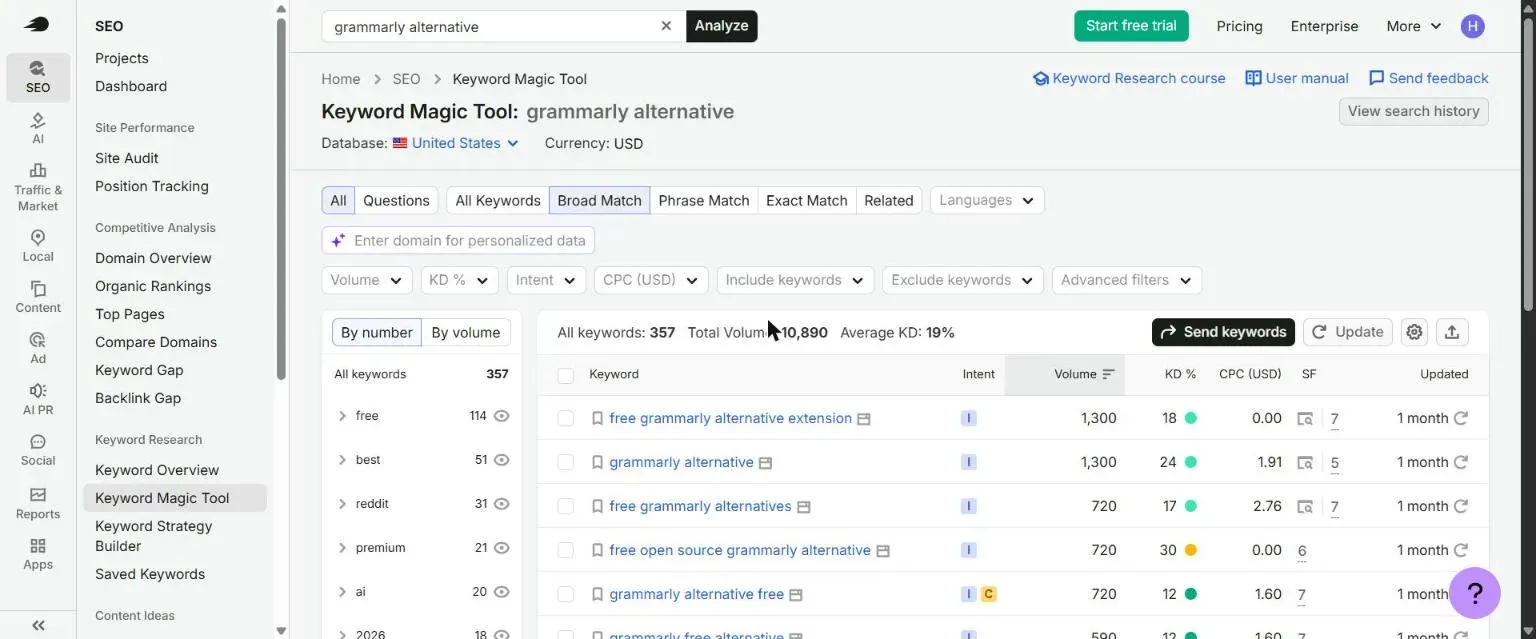
The free plan showed the first 10:
| Keyword | Searches a month (US) | Difficulty |
|---|---|---|
| free grammarly alternative extension | 1,300 | 18% |
| grammarly alternative | 1,300 | 24% |
| free grammarly alternatives | 720 | 17% |
| free open source grammarly alternative | 720 | 30% |
| grammarly alternative free | 720 | 12% |
| grammarly free alternative | 590 | 12% |
| alternative for grammarly | 480 | 18% |
| grammarly alternatives | 480 | 25% |
| free grammarly alternative | 390 | 15% |
| alternative to grammarly | 320 | 22% |
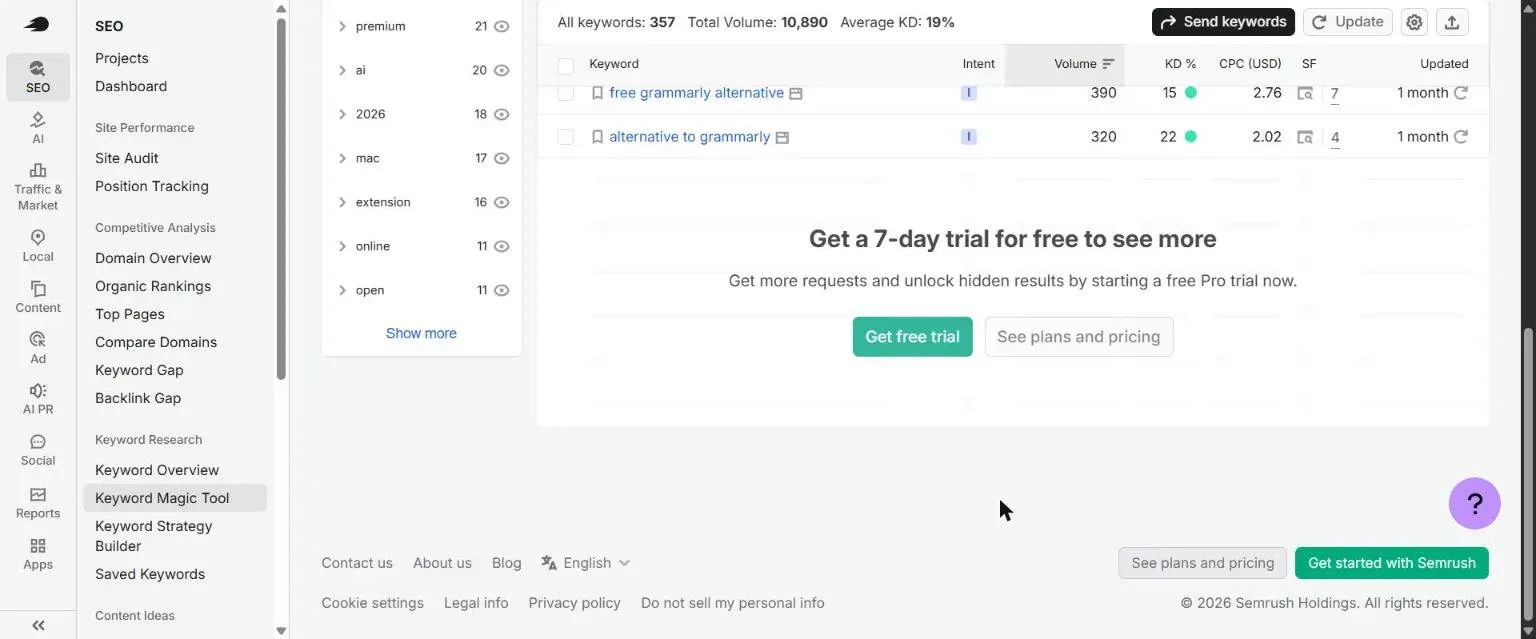
That was useful straight away. Six of the ten include the word free, which tells us what our alternatives article should focus on. Below row 10, the rest were blurred behind a box offering a 7-day free trial.
What the free plan holds back
- Most keyword ideas. 10 rows out of 357 in our search.
- Repeat audits. One audit a month in our test, and no more than 100 pages. You cannot re-check a fix straight away.
- Core Web Vitals, the page speed report in the audit, is marked “Available with a paid plan”.
- Your attention. A green “Start free trial” button sits at the top of every screen, and most reports end with an upgrade box.
Price
| Plan | Monthly | Billed yearly | Best for |
|---|---|---|---|
| Free | $0 | $0 | A small site’s audit and a few keyword checks |
| SEO Pro | $139 a month | $117.33 a month | Up to 5 websites, full keyword and backlink tools |
| Semrush One Starter | $199 a month | $165.17 a month | SEO Pro plus tracking in AI search tools |
Prices from Semrush’s pricing page on 14 November 2026. Both paid plans offer a free trial, which asks for a card.
Who should use it
Use the free plan if you run a small site and want a health check. The audit alone is worth the sign-up, and a few keyword searches will point your next article in the right direction.
Pay for SEO Pro if search traffic is a real part of your income and you will use the keyword and competitor tools every week. At $139 a month, it needs to pay for itself.
Skip the paid plans if you publish a few articles a month. The free audit plus the 10 keyword rows cover the basics.
The bottom line
Semrush’s free plan found a real problem on our site within a minute, and its first 10 keyword results changed what our next article will cover. Everything beyond that is paid, and the paid plans are expensive. Start free, and upgrade only when you are using it every week.